August 16, 1920 is a day that would go down in baseball infamy. Late that afternoon at the Polo Grounds in Upper Manhattan, Cleveland Indians' shortstop Ray Chapman stepped into the batter’s box for what would be the very last time in his life. And no, he wasn't retiring from baseball.
During the at bat, Chapman squared up, ready to bunt, but New York Yankees' pitcher Carl Mays threw a submariner that got away. The ball struck Chapman right on the temple, with the resulting hit being so loud that Mays actually fielded the ball and threw to first, thinking that perhaps Chapman had made contact with his bat.
In fact, Chapman never regained consciousness and died next day, the only major-league player ever to have suffered fatal injuries in a game.
Recent Posts
Showing posts with label new york yankees. Show all posts
Monday, May 12, 2014
Monday, May 5, 2014
The Lost Art Of The Autograph
Posted by
Jose
Baseball and autographs go hand in hand. If you've been fortunate enough to have gotten a ball signed the last time you were at the park, you may have also asked the player to write down their number on it. Chances are, if you haven't, other people may have a hard time distinguishing whose autograph that actually belong to. Case in point, this autograph:
Figured it out yet?
This Johnny Hancock belongs to none other than former Cy Young winner Tim Lincecum of the San Francisco Giants. It would be hard for almost anyone who wasn't familiar with his style of signature to be able to say it belonged to him. He isn't alone. As players today are asked more and more often to sign autographs for fans, baseball card companies, and other promotions, they are forced to make a decision: With the small amount of time allotted for autographs, should I sign less autographs, or should I modify my signature to something quicker to sign, in order to increase the amount of things I can sign? Most players these days choose the latter.
It wasn't always this. Feast your eyes on these two autographs and see if you have better luck figuring out who they belonged to:
Figured it out yet?
This Johnny Hancock belongs to none other than former Cy Young winner Tim Lincecum of the San Francisco Giants. It would be hard for almost anyone who wasn't familiar with his style of signature to be able to say it belonged to him. He isn't alone. As players today are asked more and more often to sign autographs for fans, baseball card companies, and other promotions, they are forced to make a decision: With the small amount of time allotted for autographs, should I sign less autographs, or should I modify my signature to something quicker to sign, in order to increase the amount of things I can sign? Most players these days choose the latter.
It wasn't always this. Feast your eyes on these two autographs and see if you have better luck figuring out who they belonged to:
That was a lot easier, right? Up top, you have the dean of the dignified autograph, former Minnesota Twins great Harmon Killebrew. At the bottom? I really hope I don't have to tell you that that belongs to the Great Bambino, Babe Ruth.
For more reading, check out this recent New York Times article.
Monday, April 7, 2014
Masanori Murakami
Posted by
Jose
Masahiro Tanaka has been on a tear this spring training season, giving New York Yankees fans hope that their newly signed Japanese star will help their team get back into the playoffs. While it has become commonplace for Major League Baseball to sign Japanese players from the Nippon Professional Baseball league, things were not always this way.
In 1964, three Japanese baseball players from the Osaka Nankai Hawks arrived in Arizona at the San Francisco Giants' Spring Training camp in Casa Grande, Arizona. These three pitchers were all headed to Single-A Fresno in what was termed an "exchange-student" type of event. It was expected the the Giants would eventually send over three players as well. On September 1st, one of those three, Masanori Murakami, was called up to pitch in the bigs (pitching a scoreless inning against the New York Mets), thus becoming the first Japanese pitcher in Major League history. In that final month of the season, the southpaw had nine relief appearances, a 1.80 ERA and a save. He came back the following year, where he appeared in 45 games, starting one of them, and going 4-1 with eight saves and a 3.75 ERA.
Alas, he would not return to MLB after 1965 and that ended what could have been a potentially good Major League career. There were still fresh wounds from World War II and resentment towards Japan, with Giants manager Herman Franks receiving death threats for pitching Murakami. In fact, Franks ended up needing FBI protection for a period of time. It took another 31 years for Hideo Nomo to become the second Japanese player to play for a Major League team, the Los Angeles Dodgers.
In 1964, three Japanese baseball players from the Osaka Nankai Hawks arrived in Arizona at the San Francisco Giants' Spring Training camp in Casa Grande, Arizona. These three pitchers were all headed to Single-A Fresno in what was termed an "exchange-student" type of event. It was expected the the Giants would eventually send over three players as well. On September 1st, one of those three, Masanori Murakami, was called up to pitch in the bigs (pitching a scoreless inning against the New York Mets), thus becoming the first Japanese pitcher in Major League history. In that final month of the season, the southpaw had nine relief appearances, a 1.80 ERA and a save. He came back the following year, where he appeared in 45 games, starting one of them, and going 4-1 with eight saves and a 3.75 ERA.
Alas, he would not return to MLB after 1965 and that ended what could have been a potentially good Major League career. There were still fresh wounds from World War II and resentment towards Japan, with Giants manager Herman Franks receiving death threats for pitching Murakami. In fact, Franks ended up needing FBI protection for a period of time. It took another 31 years for Hideo Nomo to become the second Japanese player to play for a Major League team, the Los Angeles Dodgers.
Thursday, May 2, 2013
Strikeouts
Posted by
Jose
April 2013 was a historic month in baseball for strikeouts. There were more strikeouts this April than in any other April in any season in major-league history. Furthermore, it was the 2nd-highest in any month in MLB history!
Here's some nice perspective Going into this year, only one players had every struck out 40 times in April. That honor was owned by Preston Wilson, who accomplished that feat in 2000 playing for the Florida Marlin.
This year, there were three players to accomplish that feat: Chris Carter of the Houston Astros, Mike Napoli of the Boston Red Sox, and Jay Bruce of the Cincinnati Reds.
And remember... Joe DiMaggio never struck out 40 times in a SEASON!
Here's some nice perspective Going into this year, only one players had every struck out 40 times in April. That honor was owned by Preston Wilson, who accomplished that feat in 2000 playing for the Florida Marlin.
This year, there were three players to accomplish that feat: Chris Carter of the Houston Astros, Mike Napoli of the Boston Red Sox, and Jay Bruce of the Cincinnati Reds.
And remember... Joe DiMaggio never struck out 40 times in a SEASON!
![]() |
| Joe DiMaggio, probably not striking out |
Saturday, December 8, 2012
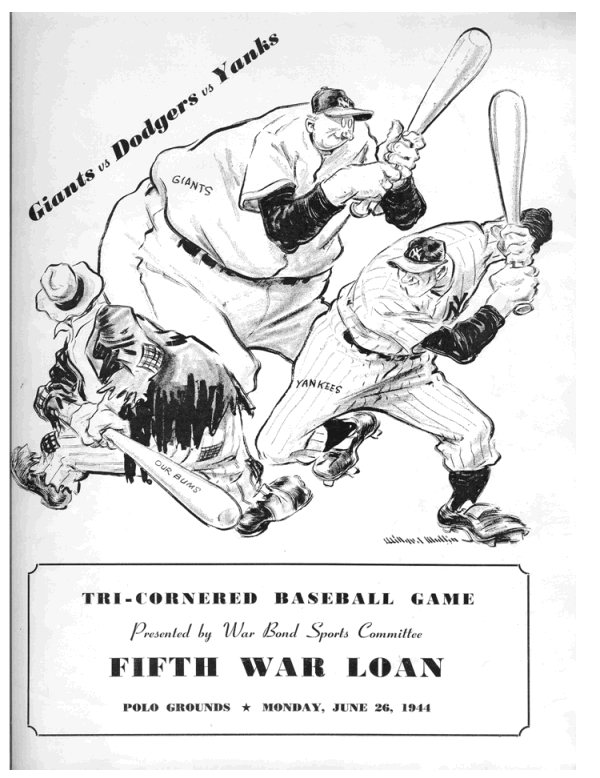
Giants vs Dodgers vs Yankees
Posted by
Jose
A three way game played on June 26, 1944 was set up to support the war effort with an unusual exhibition game played by the Yankees, Dodgers, and the Giants at the Polo Grounds. Presented by the War Bond Sports committee in connection with the Fifth War Loan. The First War Loan began on November 30, 1942. The Fifth War Loan was the largest of the eight, and by its conclusion on July 8, 1944, $20.6 billion had been raised. $56.5 million contributed by the Tri-Cornered game at the Polo Grounds.
The crowd of 50,000 contributes $5.5 million to attend, while the Bond Clothing Co. pays $1 million in bonds for an autographed program. The overwhelming majority of the money comes from the city of New York, with Mayor Fiorello La Guardia purchasing $50 million worth of bonds.
The three-cornered baseball game started with hitting, running, and throwing contests. In between contests, Al Schacht, the Clown Prince of Baseball, entertained the crowd of 50,000, and admission to the game was by purchase of series E, F, and G war bonds. The 40,000 general admission unreserved seats cost one $25 war bond; the 5,809 reserved seats in the lower stands went for a $100 bond; the box seats both upper and lower cost the fan a $1,000 war bond. Bleacher seats were free to servicemen.
The setup for a three-way nine inning game was simple: The Dodgers and Yankees played the first inning while the Giants sat out; the Dodgers and Giants played the second inning while the Yankees sat out; the Yankees and Giants played the third inning while the Dodgers sat out. The same order continued to the game's end.
The game, which lasted three hours and four minutes, was won by the Dodgers. Here is the line score:
| Inning | 1 | 2 | 3 | 4 | 5 | 6 | 7 | 8 | 9 | R |
| Dodgers | 1 | 2 | X | 0 | 0 | X | 0 | 2 | X | 5 |
| Yankees | 0 | X | 0 | 0 | X | 0 | 0 | X | 1 | 1 |
| Giants | X | 0 | 0 | X | 0 | 0 | X | 0 | 0 | 0 |
Thursday, September 20, 2012
Four Strikeouts : One Inning
Posted by
Jose
During today's game between New York Yankees and Toronto Blue Jays, a rare feat happened... Phil Hughes of the Yankees struck out four Blue Jays in one inning!
Hughes struck out J.P. Arencibia for the first out, then also fanned Adeiny Hechavarria; however, the last pitch of the at-bat tipped catcher Russell Martin’s glove and became a passed ball, allowing Hechavarria to reach first safely on the dropped third strike rule, which occurs when a catcher fails to cleanly catch the ball that led to the third strike.
The right-hander then went on to strike out Anthony Gose swinging and got Brett Lawrie on a called third strike to end the fourth inning.
Hughes struck out J.P. Arencibia for the first out, then also fanned Adeiny Hechavarria; however, the last pitch of the at-bat tipped catcher Russell Martin’s glove and became a passed ball, allowing Hechavarria to reach first safely on the dropped third strike rule, which occurs when a catcher fails to cleanly catch the ball that led to the third strike.
The right-hander then went on to strike out Anthony Gose swinging and got Brett Lawrie on a called third strike to end the fourth inning.
Monday, September 17, 2012
1963 MVP
Posted by
Jose
In 1963, Sandy Koufax of the Los Angeles Dodgers was the National League MVP, while Elston Howard was the American League MVP while playing for the New York Yankees. That same year, Jim Brown of the Cleveland Browns in the National Football League won the MVP. What was remarkable about all of this? All three players wore the number 32!
![]() |
| Sandy Koufax |
![]() |
| Elston Howard |
![]() |
| Jim Brown |
Labels:
elston howard,
jim brown,
los angeles dodgers,
new york yankees,
nfl,
sandy koufax
·
0
comments